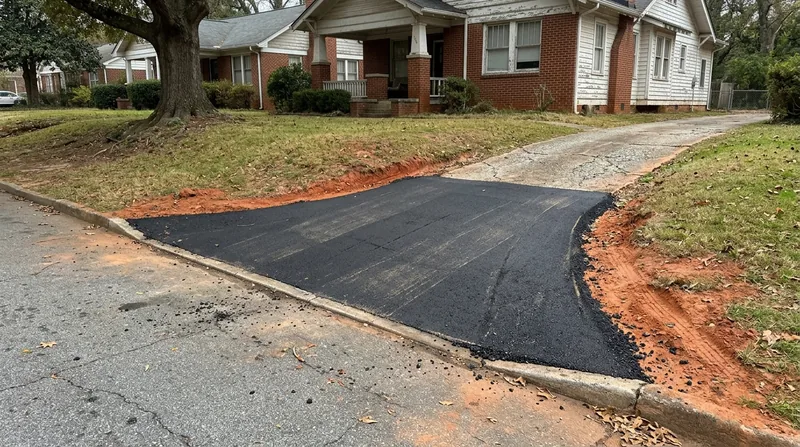




Atlanta's driveway aprons take a beating where storm water rushes off the yard toward the street, and the Piedmont clay underneath stays soft for days after a heavy rain. The craftsman bungalows intown, the ranch-ring suburbs, and the newer subdivisions north of the perimeter all share the same problem: water pooling at the edge of the slab, foundation splash-back, and erosion that undercuts the pavement. Driveway extensions, widening and aprons solve that by moving water off fast, keying new hot mix asphalt into the old edge, and pitching the whole assembly to clear the curb before it soaks in. This is not a decorative upgrade, it is a drainage fix that protects the base, the foundation, and the driveway itself. We have been doing this work since 2012, and we build every extension to shed water, not to hold it.
Why Driveway Aprons and Extensions Matter in Atlanta's Climate
Atlanta summers bring afternoon thunderstorms that dump inches of water in minutes, and the Piedmont soil underneath your driveway does not drain it away, it holds it, softens, and shifts. A driveway that ends abruptly at the property line sends all that runoff straight down the foundation wall or into the yard, where it pools and erodes. Extending the slab and widening the apron creates a continuous pitch that moves water toward the street and into the storm drain. The math is simple: a poorly pitched apron costs you a foundation repair in five years, or a full driveway replacement in ten. A well-built extension pays for itself the first time a hundred-year storm hits.
- Extend the apron to pitch water away from the foundation and toward the curb or swale.
- Widen the driveway to accommodate turn-around space or to match the lot's grading.
- Key new asphalt into the existing edge to prevent separation and edge failure.
- Compact a new aggregate base under the extension to support the slab and move subsurface water away.
- Seal the joint between old and new asphalt to stop water infiltration at the seam.
Every extension we build in Atlanta is graded to move water off the surface, not to trap it. That is the difference between a driveway that lasts and one that fails at the edge.
Key info: Atlanta's municipal codes require that driveway aprons meet specific pitch and drainage standards. Your city or county building department sets the rules for curb cuts, permitting, and impervious-surface limits. We help you navigate local permitting and confirm that the extension meets your village's requirements before we break ground. Always verify with your local building department and your HOA if you are in a master-planned community.
How We Build Driveway Extensions and Widenings in Atlanta
Every extension starts with a site visit to read the existing grade, the water flow, and the condition of the driveway edge. We measure the lot line, check for utility locates through Georgia 811, and confirm that the new apron will pitch correctly and meet local code. Then we prep the subgrade, compact a new base, and key the new hot mix asphalt into the old edge so it bonds and does not separate. The result is a single continuous slab that sheds water and handles the freeze-thaw cycles that Atlanta rarely sees but the clay does.
- Call Georgia 811 to locate all underground utilities before any grading or excavation work begins.
- Excavate the extension area to the same depth as the existing driveway, typically three to four inches of asphalt over four to six inches of compacted base.
- Proof-roll the prepared subgrade to confirm it is solid and will not settle under the new slab.
- Compact the new aggregate base in lifts, checking density to ensure proper support and drainage.
- Tack the edge of the existing asphalt with an adhesive primer so the new hot mix bonds and does not peel.
- Lay and compact the new hot mix asphalt, sloping it to shed water toward the street or swale.
- Allow the new asphalt to cure for one to two weeks before heavy traffic or sealcoating.
This process turns a drainage liability into a drainage asset, and it protects both the driveway and the foundation. See our full driveway repair service for patching and edge work on existing driveways.
Local example: A Decatur homeowner with a 1960s ranch house and a short, single-width driveway was losing water down the foundation wall every time it rained. We extended the apron by four feet, sloped it to pitch toward the street, and keyed it into the existing edge. The foundation stopped weeping, and the driveway now drains in minutes instead of holding water for days. Cost: within the range of a typical extension job for a lot that size.
Driveway Extension Methods and Approaches
The method we use depends on the existing driveway condition, the lot grade, and what you are trying to accomplish. A simple apron extension on a sound base is straightforward. A widening that requires subgrade work takes longer and costs more. A full-depth replacement under an extension is the safest bet if the existing edge is failing, but it is also the most expensive option. We will walk you through the trade-offs and recommend the approach that gives you the longest service life for the money.
| Approach | Description | Best for |
|---|---|---|
| Apron Extension | Add new asphalt to the existing edge, keyed and bonded, with proper pitch and drainage. | Driveways with sound edges and stable bases; low-cost way to improve drainage and add parking space. |
| Driveway Widening | Expand the slab width by excavating the side, preparing a new base, and laying asphalt alongside the existing slab. | Lots where turn-around space is needed or where the original driveway is too narrow for two vehicles. |
| Edge Repair with Extension | Remove failed edge, rebuild the base, and extend the slab with full-depth asphalt. | Driveways with crumbling edges or soft bases; ensures the new section will not separate or fail again. |
| Full-Depth Replacement | Remove the entire driveway, prepare a new base, and pave a larger slab that includes the extension. | Driveways that are failing throughout, or when you want to add significant width and know the base needs rebuilding. |
Each method has a different cost and timeline. We measure on site and recommend the one that makes sense for your lot and your budget.
Driveway Extensions, Widening and Aprons Cost in Atlanta: What to Expect
A straightforward apron extension in Atlanta typically starts at $1,800 for a small addition on a sound base. That covers the subgrade prep, compacted aggregate base, new hot mix asphalt keyed into the existing edge, and labor to pitch it correctly. The price moves up from there based on how much you are adding, whether the existing base needs rebuilding, and how much excavation the lot requires. A widening that adds four to six feet of new width on both sides will run higher. A full-depth replacement under an extension, where we remove the old slab and rebuild everything, is the most expensive option but also the most durable.
The best way to know what your job will cost is to get a written estimate on site. We measure the lot, check the existing conditions, and give you a tonnage spec and a firm price before we start. See our full pricing overview for the range of services we offer and what drives costs up or down.
Factors that affect the price include the size of the extension, the condition of the existing base, whether we need to rebuild the subgrade, site access for equipment, and local permitting requirements. If your lot sits on soft clay or has poor drainage, the base prep will take longer and cost more. If the lot is tight or there are trees or utilities in the way, equipment access may require extra labor or smaller machinery. Always get two or three estimates from local contractors so you can compare scope, materials, and price.
Driveway Extensions, Widening and Aprons Near Me: What Atlanta Homeowners Should Know
Hiring the right contractor for a driveway extension is about more than price. You want someone who understands Atlanta's clay soils, who knows the local building codes and permitting rules, and who will not cut corners on base prep or drainage. A contractor working out of a local address with local plates is more likely to stand behind the work than a crew that rolls through town once and disappears. Ask for references from recent jobs in your neighborhood. Ask to see the written estimate with tonnage and thickness specs. Verify that the contractor carries liability insurance and can provide a certificate on request.
- Confirm that the contractor is fully insured with general liability coverage and can provide proof on request.
- Get written estimates from at least two local contractors that include the scope of work, materials, and tonnage specs.
- Check references from recent extension or widening jobs in your area, and ask how the drainage is holding up.
- Verify that the contractor will pull or help you obtain the necessary local permits before starting work.
- Ask about the contractor's experience with Atlanta's clay soils and how they handle base prep and drainage.
- Confirm that the estimate includes the cost of a Georgia 811 utility locate and that the contractor will call before digging.
- If you are in an HOA, confirm that the extension meets the architectural standards and that you have approval before signing a contract.
We are based in Atlanta and have been doing this work since 2012. We carry liability insurance, provide written estimates with tonnage specs, and help you navigate local permitting. Call us for a free estimate at (678) 884-4654, and we will walk you through the process and answer your questions.
Driveway Extensions, Widening & Aprons in Atlanta: Pricing Guide
| Service | Price | Details |
|---|---|---|
| Apron Extension | Starting at $1,800 | Small addition on sound base, includes subgrade prep, compacted aggregate, new hot mix asphalt keyed into existing edge |
| Driveway Widening | Starting at $2,400 | Adding width to one or both sides, includes excavation, new base prep, compacted aggregate, and new asphalt slab |
| Edge Repair with Extension | Starting at $2,800 | Removing failed edge, rebuilding base, and extending with full-depth asphalt; price varies with edge length and base condition |
| Full-Depth Replacement with Extension | On estimate | Complete driveway removal and rebuild with larger slab; requires on-site assessment of subgrade and scope of work |
| Travel and Estimate | Free | No charge for site visit or written estimate; response within 24 hours in Atlanta and surrounding service areas |
Indicative pricing, the exact cost depends on square footage, finish, and site access. Free personalized estimate within 24h at (678) 884-4654.


