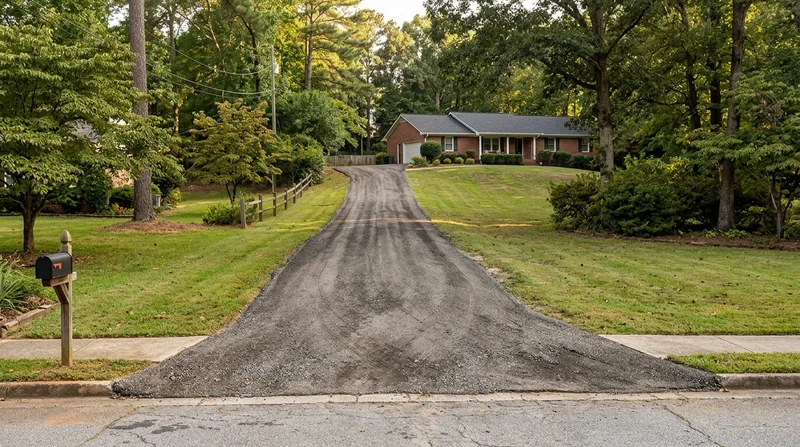




Recycled asphalt and millings driveways in Atlanta give homeowners a durable, budget-friendly surface that works with the Piedmont clay movement and summer downpours this region sees every year. Unlike fresh hot mix, recycled millings compress into a solid riding surface that sheds water fast, which matters when afternoon thunderstorms dump two inches in an hour and your red clay subgrade stays soft for days afterward. We compact recycled millings over a properly graded base so the surface handles the freeze-thaw cycles Atlanta rarely sees but the constant moisture that defines our climate. This approach costs significantly less than new asphalt while still delivering a surface that holds up to the ridge-and-valley terrain where many Atlanta driveways climb, turn and fall rather than run flat. If your driveway is sound underneath but worn on top, or if you need a temporary surface before upgrading to hot mix, millings give you years of solid performance at a fraction of the cost.
Why Recycled Millings Matter in Atlanta's Clay-Heavy Neighborhoods
Atlanta's intown core and first-ring suburbs sit on Piedmont red clay over deeply weathered saprolite, a soil that holds water and softens through a wet spell no matter how solid the surface looks. A new asphalt driveway laid over a weak or poorly draining base will fail from underneath, and the cost to replace it runs two to three times what a properly built millings drive costs upfront. Recycled asphalt millings, compacted over a graded base that channels water away from the slab, give you a surface that works with clay movement instead of fighting it. The material is crushed and sized so it knits together under traffic and settles into a tight, water-shedding mat. Homeowners in Decatur, Inman Park, and the older neighborhoods of Sandy Springs choose millings when they need a durable surface now and want to defer a full asphalt install until the base has proven itself.
- Recycled millings compress under traffic into a solid, water-shedding surface that handles Atlanta's clay subgrade movement.
- A properly graded base underneath the millings channels summer downpours away from the slab, preventing the soft-subgrade failures that plague asphalt over weak clay.
- Millings cost roughly one-third to one-half what new hot mix asphalt costs, making them the smart choice when budget is tight or when you want to test the base before committing to full replacement.
- The material is recycled asphalt, so you are reusing a proven aggregate rather than buying virgin stone, which also lowers environmental impact.
- Millings driveways hold up well in the mild Georgia winter, where freeze-thaw cycles are rare and the real threat is standing water and clay softening.
For homeowners weighing budget against durability, recycled millings are the honest middle ground between gravel and hot mix asphalt.
Key info: Atlanta's clay subgrade stays soft for days after heavy rain, which is why a well-draining base matters more than the surface material itself. Recycled millings over a properly graded base shed water fast and give you years of solid performance without the cost of new asphalt.
For more on how base preparation affects driveway longevity, see our guide to gravel driveway installation and grading in Atlanta, which covers the same drainage and compaction principles that make millings work.
How We Build a Recycled Asphalt Millings Driveway in Atlanta
A millings driveway starts with understanding what is underneath. We grade the existing surface to shed water away from the house and toward the street or a drainage point, clearing away soft spots and adding compacted stone base where the subgrade is weak. This is not guesswork, it is the work that determines whether your driveway lasts five years or ten. We then spread recycled asphalt millings over the base, typically two to three inches compacted, and roll it with a vibratory compactor so the crushed pieces knit together into a tight, unified surface. The result is a driveway that sheds water, handles traffic, and costs a fraction of new asphalt.
- We measure the drive and assess the existing subgrade to identify soft spots, poor drainage, and areas needing base repair.
- We grade the surface to a slope that sheds water away from structures and toward the street or a drainage point.
- We add compacted stone base where the subgrade is soft or unstable, building a foundation that will not settle or soften under Atlanta's summer rains.
- We spread recycled asphalt millings over the prepared base, typically two to three inches compacted thickness.
- We compact the millings with a vibratory roller until the surface is tight, uniform, and ready to shed water.
- We provide written tonnage specifications so you know exactly how much material is on the drive and can verify the work.
The entire process typically takes one to two days for a residential driveway, depending on base repairs and the size of the surface.
Local example: A ranch-style home in Brookhaven with a 500-square-foot driveway on red clay subgrade that was soft after rain. We graded the drive to shed water toward the street, added four inches of compacted stone base, and spread three inches of recycled millings over it. The homeowner now has a solid, water-shedding surface that cost roughly one-third what new asphalt would have, and the base has proven itself through two Atlanta summers.
To understand how millings fit into the broader lifecycle of driveway repair and resurfacing, see our page on asphalt resurfacing and overlay in Atlanta.
Recycled Asphalt Millings Approaches and When to Use Each
| Approach | Description | Best For |
|---|---|---|
| Millings over existing asphalt | Spread and compact recycled millings directly over a sound asphalt base that is no longer smooth but still structurally intact. | Worn asphalt driveways that need a temporary refresh before full replacement, or homeowners wanting a lower-cost surface. |
| Millings over graded and prepared subgrade | Grade the existing surface, add compacted stone base, then spread and roll recycled millings. Full base preparation ensures long-term drainage and stability. | New driveways, gravel drives being upgraded, or existing drives with poor drainage or soft subgrade. |
| Millings with stone edge containment | Add compacted stone or timber edges to contain the millings and prevent creep into adjacent lawn or landscaping. | Driveways where loose material spreading into landscaping is a concern, or where a finished edge is desired. |
| Millings as a temporary surface | Millings applied to a prepared base as a temporary driveway while you plan or save for full asphalt installation. | Homeowners who need a drivable surface now and want to defer asphalt investment, or rental properties needing short-term durability. |
Recycled Asphalt and Millings Driveways Cost in Atlanta: What to Expect
Recycled asphalt millings driveways start at roughly $3 per square foot installed, which includes grading, base preparation, and compacted millings. A typical 500-square-foot residential driveway runs between $1,500 and $2,500, depending on how much base work is needed. If the subgrade is soft and needs significant stone base, or if the drive is long and requires heavy grading, the cost moves higher. If you are laying millings over an existing sound asphalt surface with no base repairs, the cost stays at the lower end. Every driveway is different, which is why we provide written estimates with tonnage specifications so you know exactly what is included and what the material costs.
- Base preparation and grading are the largest variables in cost, since soft or poorly draining subgrade requires compacted stone that adds material and labor.
- Driveway size and shape affect cost directly, since a longer or wider drive requires more material and compaction time.
- Access and terrain matter, since a steep drive or one with limited turnaround space takes longer to grade and compact.
- Edge containment or finished borders add cost but prevent material creep and give a more polished appearance.
- Recycled millings are sold by the ton, so we specify tonnage in the estimate so you can verify the material being delivered.
To see a full pricing overview and understand how millings compare to other driveway surfaces, visit our pricing page.
Cost reality: A millings driveway costs roughly one-third to one-half what new hot mix asphalt costs, but it is not a permanent surface. Plan to re-top the drive every three to five years with fresh millings to maintain a tight, water-shedding surface. If you are looking for a one-time permanent solution, asphalt or a full-depth replacement is the better choice, and we can help you decide which makes sense for your situation.
Recycled Asphalt and Millings Driveways Near Me: What Atlanta Homeowners Should Know When Hiring
The driveway paving trade has a long history of door-to-door crews with out-of-state plates offering to use leftover material from a job nearby, asking for a large cash deposit, and disappearing before the work is done. Honest contractors are verifiably local, provide written estimates with material specifications, and stand behind their work. When you call for a millings driveway estimate, ask how the contractor plans to address your specific subgrade and drainage, request tonnage and thickness in writing, and never commit to work without a contract that spells out what is included and what the cost is.
- Verify that any contractor you hire is fully insured and can provide a certificate of insurance on request.
- Get written estimates from at least two contractors so you can compare approach, material specs, and price.
- Check references from recent millings or driveway work in your area, and ask how long the work has held up.
- Confirm that the estimate includes grading, base preparation, and tonnage specifications so you know exactly what you are paying for.
- Verify local permitting requirements with your city or county, since some jurisdictions require permits for driveway work or have impervious-surface limits.
- If you live in an HOA, check architectural guidelines before committing to millings, since some master-planned communities restrict driveway materials or require asphalt.
We have been in business since 2012 and serve Atlanta and surrounding areas with local crews and local plates. Call us at (678) 884-4654 for a free, no-obligation estimate with written tonnage specs.
For more guidance on choosing a contractor and avoiding common pitfalls, contact us or visit our service areas to see where we work.
Recycled Asphalt & Millings Driveways in Atlanta: Pricing Guide
| Service | Price | Details |
|---|---|---|
| Recycled millings over prepared subgrade | Starting at $3/sq ft | Includes grading, compacted stone base, and recycled millings rolled and compacted, typical 2 to 3 inches finished thickness |
| Millings over existing asphalt | Starting at $2/sq ft | Recycled millings spread and compacted over sound asphalt, no base work required, lower cost option for worn surfaces |
| Significant base repair or grading | On estimate | Soft subgrade, poor drainage, or extensive grading needed increases cost due to additional stone base and compaction labor |
| Edge containment or finished borders | Add $0.50 to $1.00/sq ft | Compacted stone or timber edges prevent material creep and provide a polished finished appearance around the drive perimeter |
| Travel and free estimate | Included in Atlanta area | No separate mileage fee or call-out charge, response within 24 hours at (678) 884-4654, written estimate with tonnage specs |
Indicative pricing, the exact cost depends on square footage, finish, and site access. Free personalized estimate within 24h at (678) 884-4654.


