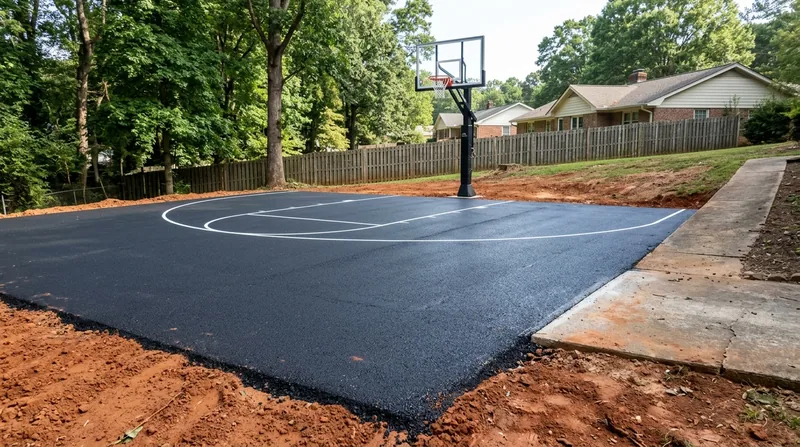




Sports Court & Path Paving in Atlanta starts with understanding what the Piedmont clay does when rain comes and when it dries. A backyard basketball court or tennis court in Fulton, DeKalb, or the northern suburbs sits on soil that shifts seasonally, holding water through Atlanta's humid summers and contracting in dry spells. The surface you play on has to move with that ground without cracking or settling into low spots. We grade and compact a stable base built for the local clay, then finish with hot mix asphalt so the court stays flat and plays true through Atlanta's afternoon thunderstorm season and the occasional ice event that freezes the top inch but rarely penetrates deep. A walking or jogging path that drains properly and stays intact through years of foot traffic follows the same principle: solid base, proper pitch, and asphalt that bonds to the ground beneath it rather than floating on unstable soil.
Why Sports Court & Path Paving Matters in Atlanta: Clay, Drainage, and Year-Round Play
Atlanta sits on Piedmont red clay that behaves differently than the sandy or limestone bases you find in other parts of the Southeast. When rain falls, the clay holds water; when the sun beats down, it shrinks and hardens. A court or path built without accounting for that movement will settle unevenly, crack at the edges, or develop low spots where water pools after a storm. The asphalt surface itself is only part of the answer. The base beneath it, how it is graded, compacted, and pitched to shed water, determines whether your court plays flat for ten years or starts failing in three.
- Improper grading leaves water trapped under the surface, softening the clay and causing the asphalt to settle and crack.
- A base that is not compacted densely enough will shift when the soil beneath it moves through wet and dry cycles.
- Poor drainage at the edges allows water to undermine the perimeter, lifting and breaking the court.
- Courts and paths built on ungraded lots, common in Atlanta subdivisions, fail faster because the underlying slope fights the pitch you need.
Getting the base right means the court or path stays playable and looks solid for years. That is why we spend time on grading and base preparation before the first truckload of asphalt arrives on site.
Local example: A residential court in Brookhaven or Dunwoody on a lot that slopes toward the house needs careful regrading to pitch water away from the foundation and the court itself. We set the base pitch to move water off the slab, not toward it, and compact the aggregate so the clay underneath stays stable through the spring thaw and summer storms.
For more information on how base preparation affects all asphalt work in this region, see our guide to gravel driveway installation and grading, which covers the same principles of drainage and compaction that underpin court and path construction.
Georgia's Department of Transportation and local municipal codes set rules for drainage, grading, and surface standards for recreational facilities. Always verify local permitting requirements with your city or county before work begins. Georgia's Department of Revenue maintains contractor information resources for homeowners seeking to verify any contractor's standing.
How We Build a Sports Court or Path: Grading, Base, and Hot Mix Asphalt
The work happens in stages, and each one matters. We start by measuring and marking the court or path, then grade the existing ground to create a stable, pitched surface that sheds water. Once the grade is set, we bring in compacted aggregate (crushed stone and recycled asphalt) and proof-roll it to confirm it will not settle under traffic. Then we lay hot mix asphalt in lifts, compact it while it is still warm, and finish with a smooth top course that plays true and drains properly.
- We measure and stake the court or path to the dimensions and slope you need, accounting for drainage and any obstacles on the property.
- We excavate and regrade the site, removing soft or unstable soil and building up a compacted base of crushed stone and recycled asphalt.
- We proof-roll the base with heavy equipment to confirm it will support the asphalt and traffic without settling or rutting.
- We lay hot mix asphalt in two or three lifts, compacting each lift while it is warm to achieve density and bond between layers.
- We finish with a smooth top course, pitched to shed water and ready for play within 24 to 48 hours of completion.
The whole process takes three to five days for a typical residential court, depending on site prep and weather. We do not lay asphalt in rain or when temperatures are below 50 degrees Fahrenheit, so winter work in Atlanta is possible but less predictable than spring and fall.
Example project: A tennis court in Roswell or Alpharetta on a sloped lot starts with regrading to create a level play surface and a pitch at the ends for drainage. We build a four-inch compacted base, lay two inches of hot mix, and finish with a half-inch top course. The court is ready for play in two days and will hold up through a decade of Atlanta weather if maintained properly.
For similar base-building expertise applied to driveway work, see our page on asphalt driveway paving and installation.
| Approach | Description | Best for |
|---|---|---|
| New Court or Path Construction | Full site grading, compacted base, and hot mix asphalt in multiple lifts to build a durable, level playing surface. | Residential backyard courts, walking paths, and jogging trails on unimproved or poorly graded lots. |
| Resurfacing an Existing Court | Milling the top layer and laying new asphalt on a stable base, without full excavation or regrading. | Courts that are intact at the base but worn, cracked, or losing traction on the top surface. |
| Base Repair and Regrade | Excavation, removal of soft soil, regrading to correct slope, and installation of new compacted aggregate base. | Courts settling unevenly, pooling water at edges, or showing signs of base failure such as rutting or soft spots. |
| Patching and Spot Repair | Full-depth patching of isolated cracks, potholes, or surface failures without disturbing the entire court. | Courts in good overall condition with localized damage from settling, impact, or edge deterioration. |
Sports Court and Path Paving Cost in Atlanta: What to Expect
A new residential backyard court or path in Atlanta starts at around $8,500 for a modest-sized court (roughly 2,000 to 2,500 square feet) with standard grading and a four-inch compacted base topped with two inches of hot mix asphalt. The price moves up or down based on several real factors: the current grade and drainage of the lot, the depth and stability of the soil beneath it, the size of the court or path, access for equipment, and the complexity of the pitch needed to shed water properly.
A tennis court (about 2,600 square feet) will cost more than a small basketball court (1,500 to 2,000 square feet). A lot that requires significant regrading, removal of soft clay, or installation of a new drainage system will cost more than a lot that is already reasonably graded. A path that winds through trees or crosses uneven terrain will cost more than a straight, level court in an open yard.
The only way to get an accurate number is to have someone visit the site, measure, assess the soil and drainage, and give you a written estimate with tonnage and thickness specifications. We provide free estimates within 24 hours. Call us at (678) 884-4654 or visit our pricing page for more detail on how we structure estimates and what moves the cost up from the starting point.
Cost drivers in Atlanta: Piedmont clay that requires excavation and replacement adds $1,500 to $3,000. A lot that slopes steeply toward the house or into a neighbor's yard needs careful regrading to avoid drainage problems, which increases labor. Access for the asphalt truck and compaction equipment is tight on some lots, especially in older neighborhoods like Decatur or Intown Atlanta, and may require hand-laying or smaller equipment at a premium cost.
Always get two or three estimates. A written estimate should include the square footage, the thickness of each layer (base and asphalt), the tonnage of material, and a clear scope of what is and is not included. Avoid any estimate that is significantly lower than others, or that does not specify thickness and tonnage. Those are the markers of a contractor cutting corners or planning to use substandard material.
Sports Court and Path Paving Near Me: What to Look for When Hiring a Contractor in Atlanta
A good paving contractor is local, insured, and willing to explain the work in detail before you sign anything. Georgia does not require a state paving license for jobs under $2,500, but most residential courts and paths exceed that threshold, and the homeowner should verify any contractor's licensing and insurance status before hiring. Ask to see proof of insurance coverage and get everything in writing, including the dimensions of the court, the thickness of each layer, the tonnage of asphalt, and the timeline for completion.
Check references, especially from work done in your neighborhood or on similar soil and terrain. A contractor who has built courts in Brookhaven, Dunwoody, or Smyrna understands the local clay and drainage challenges better than someone passing through from out of state. Avoid any contractor who shows up unsolicited at your door, offers a price on the spot without visiting the site, or asks for a large cash deposit before work begins. Those are the classic red flags of a scam.
- Verify that the contractor is fully insured and ask to see a certificate of insurance naming you as an additional insured.
- Get a written estimate that includes square footage, layer thickness, tonnage, and a detailed scope of work.
- Ask about the contractor's experience with Atlanta soil, drainage, and the specific challenges of the Piedmont region.
- Check references from recent work in your area, especially on similar lot grades and soil types.
- Confirm that the contractor understands local permitting requirements and will help you navigate them with your city or county.
- Avoid any contractor who offers a price without visiting the site, who asks for cash in advance, or who pressures you to decide immediately.
A reputable contractor will take time to understand your lot, explain the work clearly, and give you a fair price based on real site conditions. If you are ready to move forward, contact us for a free estimate. We have been serving Atlanta and the surrounding area since 2012, and we are happy to answer any questions about how we work or what your court or path will cost.
Sports Court & Path Paving in Atlanta: Pricing Guide
| Service | Price | Details |
|---|---|---|
| Residential Basketball or Tennis Court | Starting at $8,500 | New court with grading, four-inch compacted base, two inches hot mix asphalt, sized 1,500 to 2,600 square feet |
| Jogging or Walking Path | Starting at $6,200 | Graded and compacted base with two-inch hot mix top course, typical width four to six feet, length varies by property |
| Base Repair and Regrading | Starting at $3,500 | Excavation, soil removal, regrading for drainage, new compacted aggregate base, excludes asphalt overlay |
| Resurfacing Existing Court | Starting at $4,200 | Milling and removal of worn top layer, new two-inch hot mix asphalt, assumes stable base and proper drainage |
| Complex Site or Full Replacement | On estimate | Significant soil issues, drainage installation, extensive regrading, or large multi-court projects require site visit and detailed assessment |
| Estimate and Site Visit | Free | No obligation, response within 24 hours at (678) 884-4654, includes measurement, soil assessment, and written estimate with tonnage |
Indicative pricing, the exact cost depends on square footage, finish, and site access. Free personalized estimate within 24h at (678) 884-4654.


