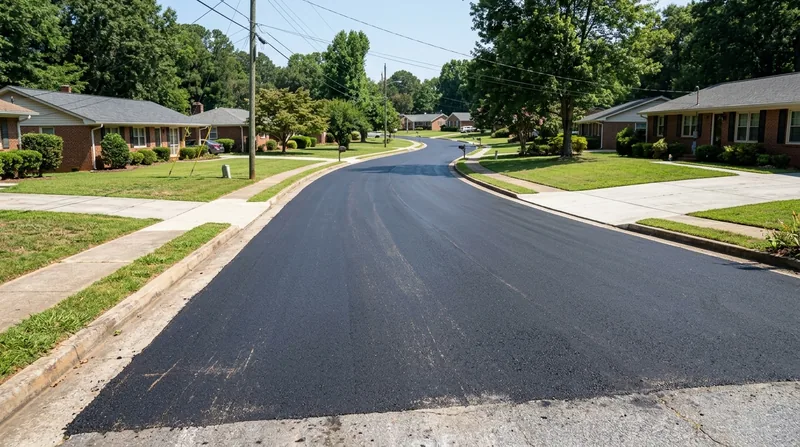




Private Road & HOA Paving in Atlanta addresses a problem that emerges across the suburban belt every fifteen to twenty years: roads built in a single construction wave begin to fail together. Gwinnett and Cobb subdivisions, along with master-planned communities in Alpharetta, Roswell, and Marietta, share a common history: their first-generation private roads and HOA lanes were laid in the 1990s and 2000s over base courses sized for the drainage and traffic patterns of that era. Today, those roads face alligator cracking, edge failure, and subsurface softening driven by Georgia's humid summers, clay subgrades that stay saturated after afternoon thunderstorms, and the simple wear of two decades of daily use. Rebuilding a private road or HOA lane means more than patching; it means excavating to the base, correcting drainage, and laying new asphalt on a compacted aggregate foundation that will shed water rather than trap it. We handle the full scope: base reconstruction, drainage correction, milling when required, and new hot mix asphalt laid to thickness and compaction specs that hold.
Why HOA Roads Fail in Atlanta: The Drainage and Clay Problem
Atlanta's private roads and HOA lanes fail for a specific reason: the Piedmont red clay that underlies most of the metro area holds water. When a road was built on a base course that was never engineered for drainage, water migrates upward through freeze-thaw cycles (rare but real in winter ice events) and through capillary action during wet spells. The asphalt surface cracks, water enters the base, the subgrade softens, and the road develops the characteristic alligator pattern that signals base failure. This is not a surface problem, and it is not a problem that an overlay alone will solve. The road must be rebuilt from the subgrade up.
- We excavate the failed section to the subgrade and evaluate soil conditions for compaction and bearing capacity.
- We install or correct the base course with compacted aggregate sized to move water laterally and downward, not trap it.
- We verify drainage by proof rolling and visual inspection before laying asphalt.
- We lay hot mix asphalt at the thickness required for the road's traffic load and local climate.
- We compact the new asphalt to density and finish it with proper crown and edge detail so water runs off rather than pooling.
The result is a road that sheds water, resists the push-and-pull of Georgia's seasonal weather, and carries traffic for twenty years or more without the premature failure that plagued the first generation of roads in these subdivisions.
Local example: A typical Gwinnett subdivision built in 1998 has roads that were paved over a 4-inch base course with no engineered drainage layer. By 2018, those roads showed alligator cracking across 40 to 60 percent of the surface. An overlay would have failed within three to five years. Full base reconstruction, new 6-inch base course with perforated underdrain, and 2.5-inch hot mix asphalt gives those roads another twenty years of service life.
For more on how asphalt fails and when repair stops making sense, see our guide to asphalt resurfacing and overlay decisions.
How We Rebuild Private Roads and HOA Lanes in Atlanta
Rebuilding a private road is a phased operation that requires coordination with the HOA, careful sequencing to keep access open, and precise control of base preparation and asphalt placement. We begin with a site visit to measure the road, assess the subgrade, and identify drainage problems. We then produce a written estimate that specifies the excavation depth, base course thickness, asphalt thickness, and tonnage required. Once the HOA approves, we schedule the work, notify residents, and execute the job in phases if the road must stay partially open during construction.
- We call Georgia 811 to locate all underground utilities before any excavation begins.
- We mill and remove failed asphalt and excavate to the depth required to reach stable subgrade.
- We grade the subgrade, proof roll it, and correct any soft spots or ponding areas.
- We place and compact the base course in lifts, testing density as we go.
- We lay hot mix asphalt in a single or two-lift operation, depending on the thickness spec, and compact to the density required by Georgia DOT standards for hot mix.
- We finish the road with proper crown, edge detail, and any required markings or apron work.
The entire process typically takes one to three weeks for a road of moderate length, depending on weather, subgrade conditions, and whether the road must remain partially open during construction.
Typical project: A private road in Sandy Springs serving twelve homes, 400 feet long and 20 feet wide. Excavation reveals 3 inches of failed asphalt and 2 inches of deteriorated base over red clay. We mill and haul the failed material, excavate 6 additional inches of subgrade, place a new 6-inch compacted base, and lay 2.5 inches of hot mix asphalt. Total tonnage: 95 tons of asphalt, 120 tons of base material. Cost typically runs $18,000 to $22,000 depending on subgrade conditions and haul distance. Timeline: 5 working days.
Learn more about the choices in milling and removal, which is often the first step in a road rebuild.
Methods for Private Road and HOA Paving in Atlanta
| Approach | Description | Best For |
|---|---|---|
| Full Reconstruction | Excavate to subgrade, replace base course, install new asphalt on compacted aggregate foundation with engineered drainage. | Roads with alligator cracking over 40 percent of surface, soft subgrades, or failed base courses. |
| Mill and Overlay | Remove top 1.5 to 2 inches of asphalt, recompact the remaining base, and lay new hot mix asphalt on top. | Roads with surface cracking and wear but a solid base course underneath, typically under 15 years old. |
| Spot Repair and Patching | Full-depth patches or pothole repairs in localized areas, with proper tack coat and compaction to match existing surface. | Roads with isolated failed sections, potholes, or edge failures while the majority of the road remains sound. |
| Base Repair and Regrading | Excavate and replace failed base course sections, improve crown and drainage, and repave without removing all existing asphalt if the surface is serviceable. | Roads with subsurface failure and ponding but where the asphalt surface is not yet alligatored across the full width. |
Private Road and HOA Paving Cost in Atlanta: What to Expect
The cost of rebuilding a private road or HOA lane in Atlanta depends on the road's length and width, the depth of excavation required, the condition of the subgrade, and whether drainage improvements are needed. A typical private road serving a small subdivision, roughly 400 to 500 feet long and 18 to 22 feet wide, with full base reconstruction and new asphalt, runs starting at $15,000 to $25,000. Longer roads, roads with severe subgrade issues, or roads requiring additional drainage work cost more. A one-mile private road in a larger Cobb or Gwinnett subdivision can easily reach $60,000 to $100,000 or more.
The largest cost drivers are excavation depth (if the subgrade is soft, we dig deeper and replace more material), base course tonnage (a 6-inch base course over a 400-foot road costs significantly more than a 4-inch course), asphalt tonnage (thicker roads cost more per linear foot), and site access (if the road is narrow or has limited turnaround space, equipment costs more to stage and move). Subgrade conditions in Atlanta, where red clay predominates, often require deeper excavation than roads built in areas with stable sand or gravel subgrades.
We provide a written estimate that specifies tonnage, thickness, and scope so you understand exactly what the cost covers. We recommend getting two or three estimates from local paving contractors to compare approach and price. See our full pricing guide for more detail on what moves costs up or down.
Private Road and HOA Paving Near Me: What to Look for When Hiring a Contractor in Atlanta
Hiring the right contractor for a private road or HOA paving project is critical because the work is large, the cost is significant, and the road will carry traffic for twenty years. The contractor must understand Atlanta's soil conditions, have experience with HOA coordination, and be able to specify and execute proper base preparation and asphalt placement. Here is what to verify before you sign a contract.
- Ask the contractor for a written estimate that specifies excavation depth, base course thickness and tonnage, asphalt thickness and tonnage, and the method of compaction and testing.
- Verify that the contractor carries liability insurance and can provide a certificate of insurance naming the HOA as an additional insured.
- Confirm that the contractor understands local permitting: some municipalities require permits for private road work, and some do not, but the HOA may have its own architectural standards or require board approval before work begins.
- Ask whether the contractor will call Georgia 811 before excavation to locate utilities, and whether they carry workers compensation insurance if they have employees.
- Get references from three to five similar projects (private roads or HOA lanes, not just residential driveways) and call those references to ask about quality, timeline, and whether the contractor communicated clearly with the HOA.
- Avoid contractors who pressure you to sign a contract immediately, demand a large cash deposit upfront, or refuse to provide a detailed written estimate with tonnage and thickness specifications.
The paving industry attracts itinerant crews that arrive in unmarked trucks, offer a price that seems too good, demand cash, and disappear if problems emerge. A local contractor with a local address, local plates, and verifiable references is your best protection. Call us at (678) 884-4654 for a free estimate and a conversation about your road's condition and your HOA's timeline. We have been serving Atlanta since 2012 and can walk you through the process.
For more on choosing a contractor and avoiding common pitfalls, contact us today to discuss your project and get a free, no-obligation estimate.
Private Road & HOA Paving in Atlanta: Pricing Guide
| Service | Price | Details |
|---|---|---|
| Private road, 300-500 feet, full base reconstruction | Starting at $15,000 | Includes excavation, new base course, hot mix asphalt; cost rises with depth of excavation and subgrade conditions |
| Larger HOA road, 800-1200 feet, full reconstruction | Starting at $35,000 | Scaled for typical Gwinnett or Cobb subdivision; tonnage and subgrade complexity are primary cost drivers |
| Mill and overlay, 400-600 feet, sound base | Starting at $8,000 | Surface removal and new asphalt only; no excavation; suitable for roads under 15 years old with good base |
| Complex or mile-long roads, severe subgrade issues | On estimate | Requires site visit to assess excavation depth, drainage needs, and utility conflicts before pricing |
| Estimate and site visit | Free | Written estimate with tonnage and thickness specs, delivered within 24 hours, no obligation to proceed |
Indicative pricing, the exact cost depends on square footage, finish, and site access. Free personalized estimate within 24h at (678) 884-4654.


